
Experience can change.
The simulator and Python state persist across submissions. The agent revises control code, Skills, and Lessons, and can reset the same scene to try again.
Explore through code, retain Skills & Lessons, then freeze that experience for fresh agents in independent scenes.
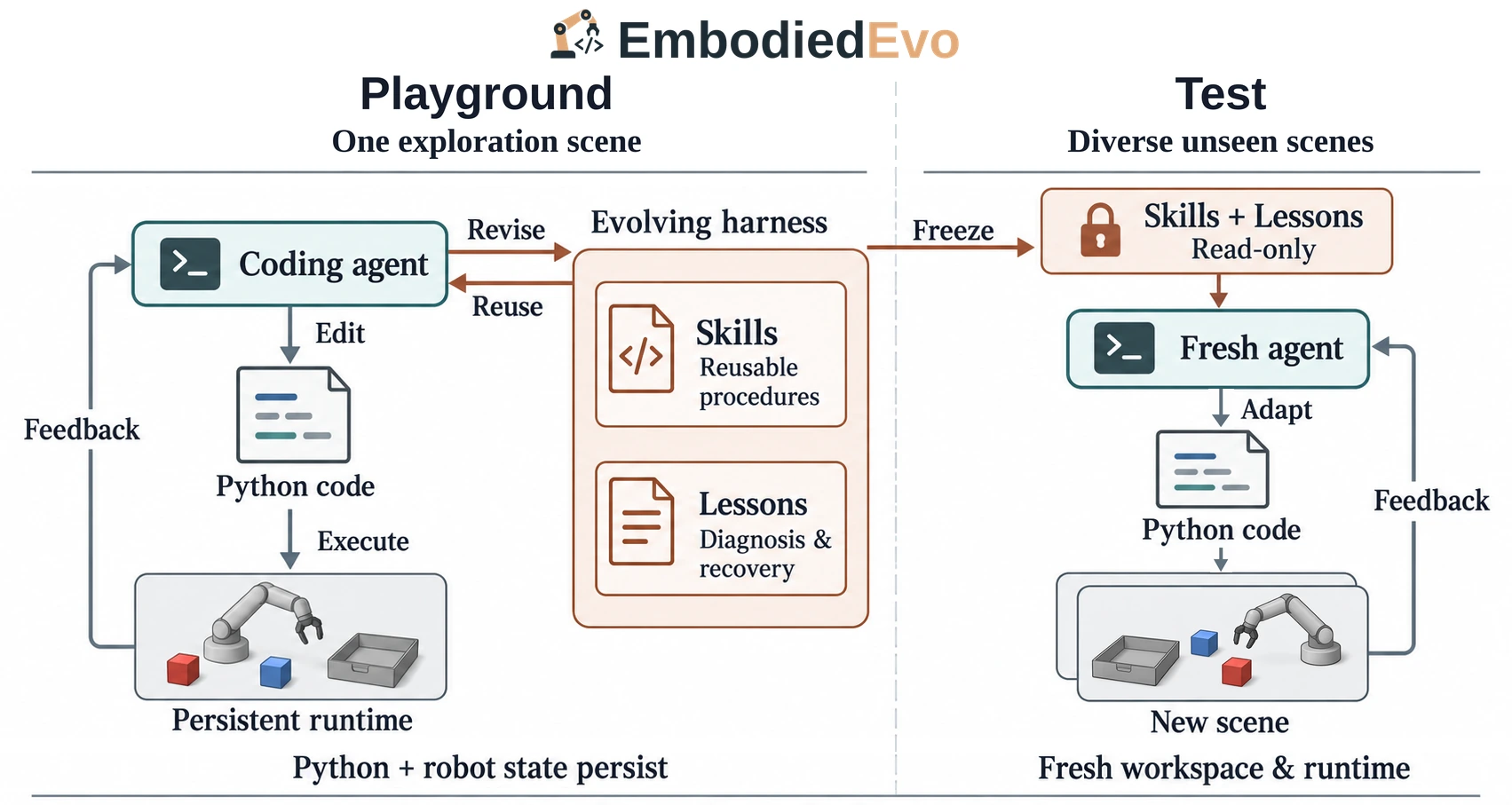
The coding agent writes and executes Python in a persistent robot session. It observes what happened, revises the next segment, and can reset in the Playground.
The agent emits executable Python segments. A segment can combine numerical reasoning, conditionals, loops, and reusable routines before calling the robot’s native controller.
RoboDojo exposes RGB images and robot state. The native controller handles inverse kinematics and interpolation; object ground-truth poses, depth, and camera calibration are unavailable.
get_instruction()Read the taskget_observation()Inspect the current statestep(action)Execute native controlreset()Playground only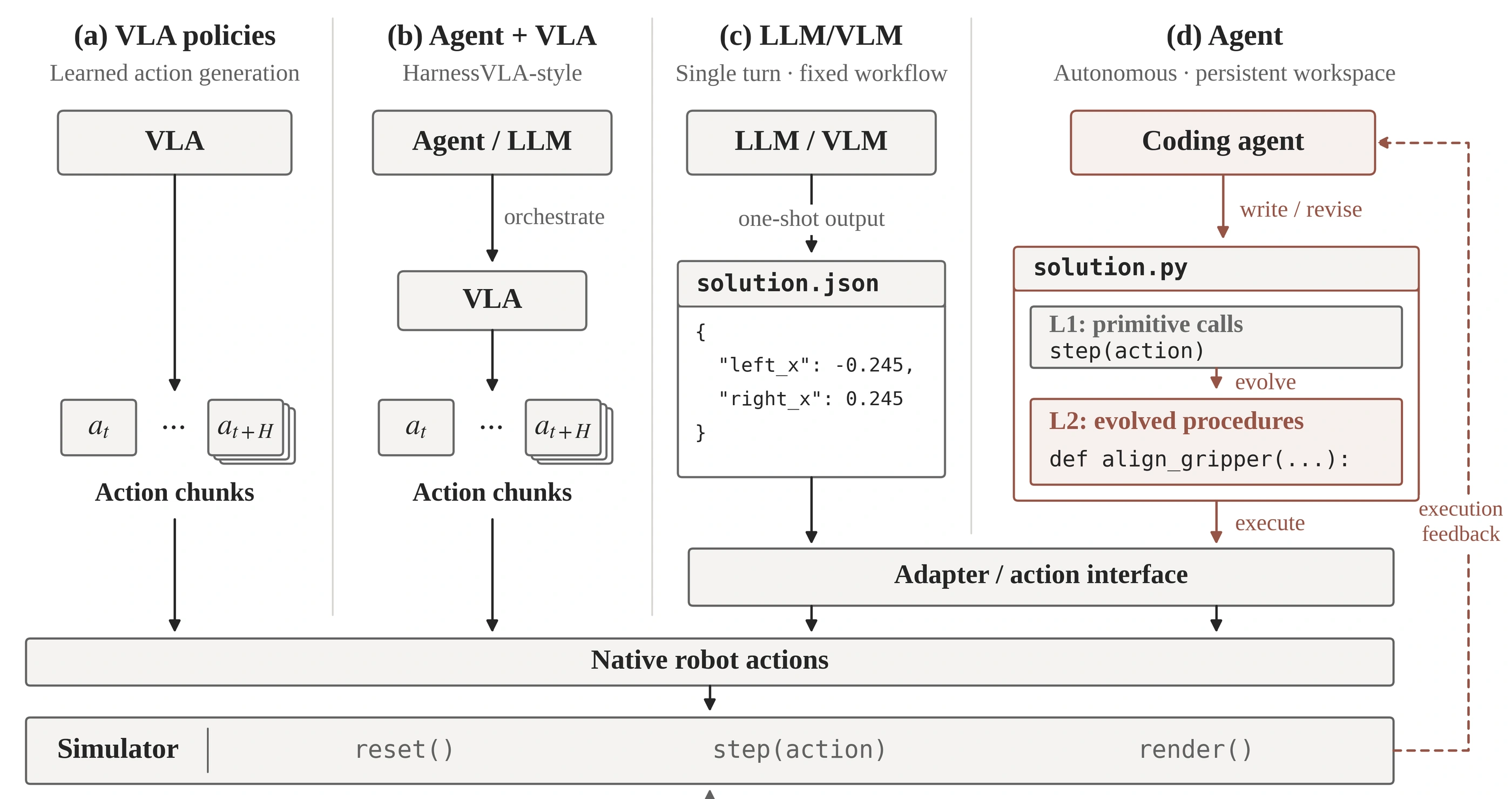
The simulator and Python state persist across submissions. The agent revises control code, Skills, and Lessons, and can reset the same scene to try again.
Each scene gets a fresh agent, workspace, Python namespace, and simulator. Local programs still adapt through feedback. Inherited files are read-only, reset is disabled, and Test scenes share no new experience.
Model weights, task goals, native primitives, and success conditions stay fixed. Each Playground chain and Test episode allows up to 100 code executions, subject to the task’s native-action allowance.
With task descriptions alone or with the wiki, frozen Skills & Lessons raise success by more than 21 percentage points on matched scenes.
success rate
95% CI: 12.33 to 31.39 pp| Experience | Score ↑ | Success rate ↑ |
|---|---|---|
| No experience | 14.77 | 8.50% |
| Skills & Lessons | 38.64 | 30.17% |
success rate
| Experience | Score ↑ | Success rate ↑ |
|---|---|---|
| No experience | 20.67 | 13.36% |
| Skills & Lessons | 42.42 | 35.08% |
A reusable grasp enables repeated placements; an observation lesson helps the agent wait for a complete sequence. Precise contact still limits task completion.
Both tasks become successful with inherited control procedures.
The agent observes the new sequence before reproducing it.
Tube and key insertion gain partial Score but remain at 0% success. In the key case, the handover fails before insertion even begins.
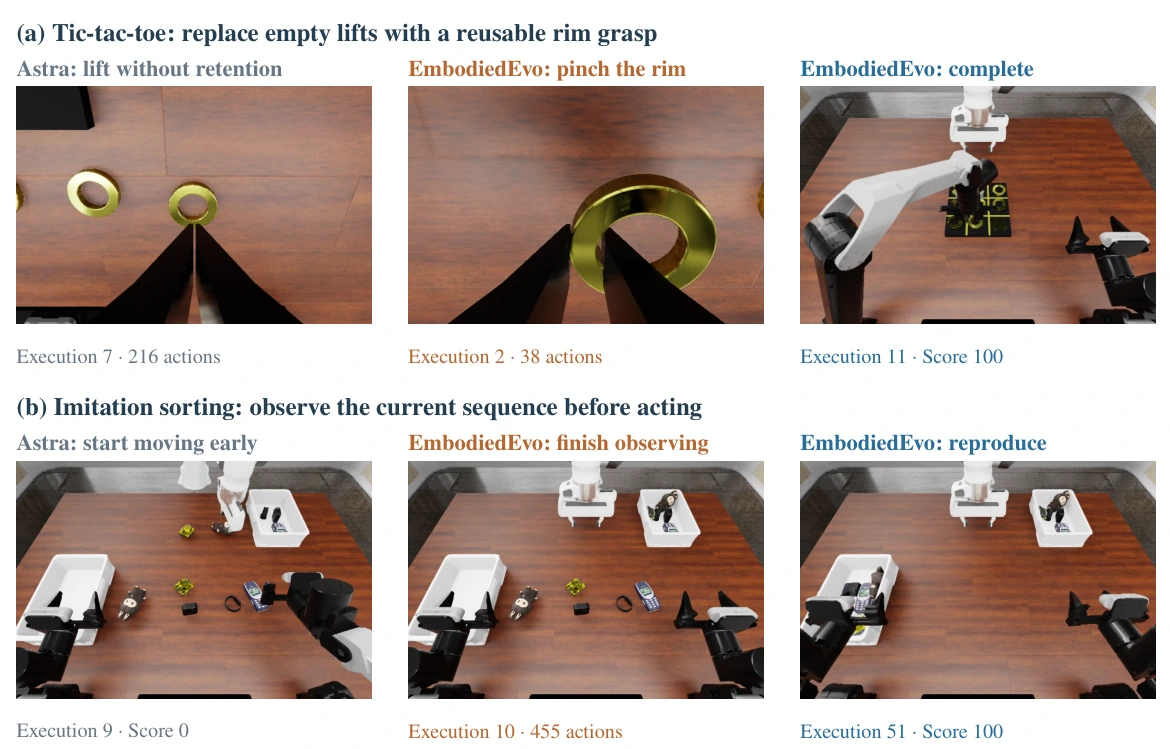
The tic-tac-toe agent reuses rim_pick to retain a ring and complete the board. The sorting agent waits to observe an order different from Playground. These traces show how Skills and Lessons are used; they do not isolate either artifact’s causal effect.
Weaker executors use knowledge they struggle to acquire. On twelve target tasks, experience from other tasks also helps without new target-task exploration.
GPT-6 Astra
GPT-6 Astra
GPT-5.6 Sol
GPT-5.6 Luna
Sol and Luna gain no task-completion benefit from their own harnesses. Astra-produced experience raises their success rates by 8.86 and 5.50 percentage points over no experience. Astra/medium also benefits from the higher-effort producer.
On twelve fixed targets, related sources add 14.72 pp success and mismatched sources add 16.67 pp, without target-task exploration. The ordering reverses across individual tasks: applicability depends on the retained operations, not just label similarity.
| Experience source | Score | Success |
|---|---|---|
| No experience | 7.35 | 1.67% |
| Same-task experience | 31.78 | 23.06% |
| Related-task source | 21.53 | 16.39% |
| Mismatched source | 26.00 | 18.33% |
Image-conditioned conveyor pickup never succeeds in Playground, yet the retained operations help fresh agents complete the task on new scenes.
The Playground task remains unfinished after 100 executions. Execution 74 still establishes a tracked grasp and test lift in 31 native actions. Frozen Skills & Lessons carry that local progress into Test.
| Test experience | Score | Success |
|---|---|---|
| No experience | 0 | 0% |
| Skills & Lessons | 40 | 40% |
Moving-target capture and contact-guarded transport provide reusable parts of the task.
Lessons tell the next agent to update its targets as the conveyor moves. Partial success in an operation can help even without a complete successful episode.
Skills & Lessons achieve similar observed success to raw history at lower Test expense, while costing more than execution without experience.
8.50% success · 14.77 Score
29.78% success · 36.41 Score
30.17% success · 38.64 Score
Skills & Lessons use 11.3% fewer total Test tokens than raw history (3.958M vs. 4.460M per episode), with similar observed success: 30.17% vs. 29.78%. The 87.9% reduction in uncached input explains the larger cost saving under the paper’s fixed token rates.
EmbodiedEvo has the highest average Score and success rate among the paper’s seven compared systems, ahead of VPP2 by 5.22 Score points and 5.56 success-rate points. Memory and Open lead their categories; Precision and Long-Horizon remain below the strongest listed systems.
| Model / contributor | Type | Score/SR | Score/SR | Score/SR | Score/SR | Score/SR | Score/SR |
|---|---|---|---|---|---|---|---|
 EmbodiedEvoOurs Navers Lab · Einsia AIAgent | Agent | 44.48/37.82% | 34.12/29.67% | 23.65/13.25% | 37.20/23.50% | 71.90/69.67% | 55.52/53.00% |
 VPP2 RobotEraWAM | WAM | 39.26/32.26% | 36.38/29.50% | 43.03/35.17% | 56.28/37.00% | 56.01/55.56% | 4.61/4.08% |
 PhysicalRSI HKU MMLab & KAIAgent + VLA | Agent + VLA | 36.27/31.38% | 21.30/15.62% | 38.05/32.50% | 46.37/37.33% | 46.74/46.56% | 28.88/24.92% |
 Awomo-0.5 AwomoWAM | WAM | 35.34/29.64% | 30.31/23.84% | 39.65/33.50% | 40.36/26.75% | 42.27/41.22% | 24.09/22.92% |
 Simate-beta SimateVLA | VLA | 33.95/27.96% | 35.09/27.95% | 34.35/26.92% | 57.84/43.42% | 33.33/33.00% | 9.12/8.50% |
 InternW0-Δ Shanghai AI LabWAM | WAM | 30.77/23.91% | 30.09/22.78% | 31.98/23.25% | 46.29/29.33% | 34.67/34.00% | 10.84/10.17% |
 GPT-6-Astra RoboDojo TeamAgent | Agent | 28.97/22.48% | 33.36/30.50% | 12.65/4.00% | 21.45/8.25% | 43.04/38.67% | 34.36/31.00% |
The study evaluates one generation of experience acquisition and inheritance in RoboDojo simulation. Sustained improvement across generations and real-hardware performance remain open questions.