01 Environments
From real manipulation to simulation
Real robot demonstrations ground task goals and scene construction. Resettable physics environments make repeated interaction and automatic verification possible.
Toward the Scaling Era of Agentic Robotics
via Real-to-Sim Environments
10,807 environments8 task families







10,807 environments span single-arm Franka and dual-arm AgileX manipulation, organized into eight task families.
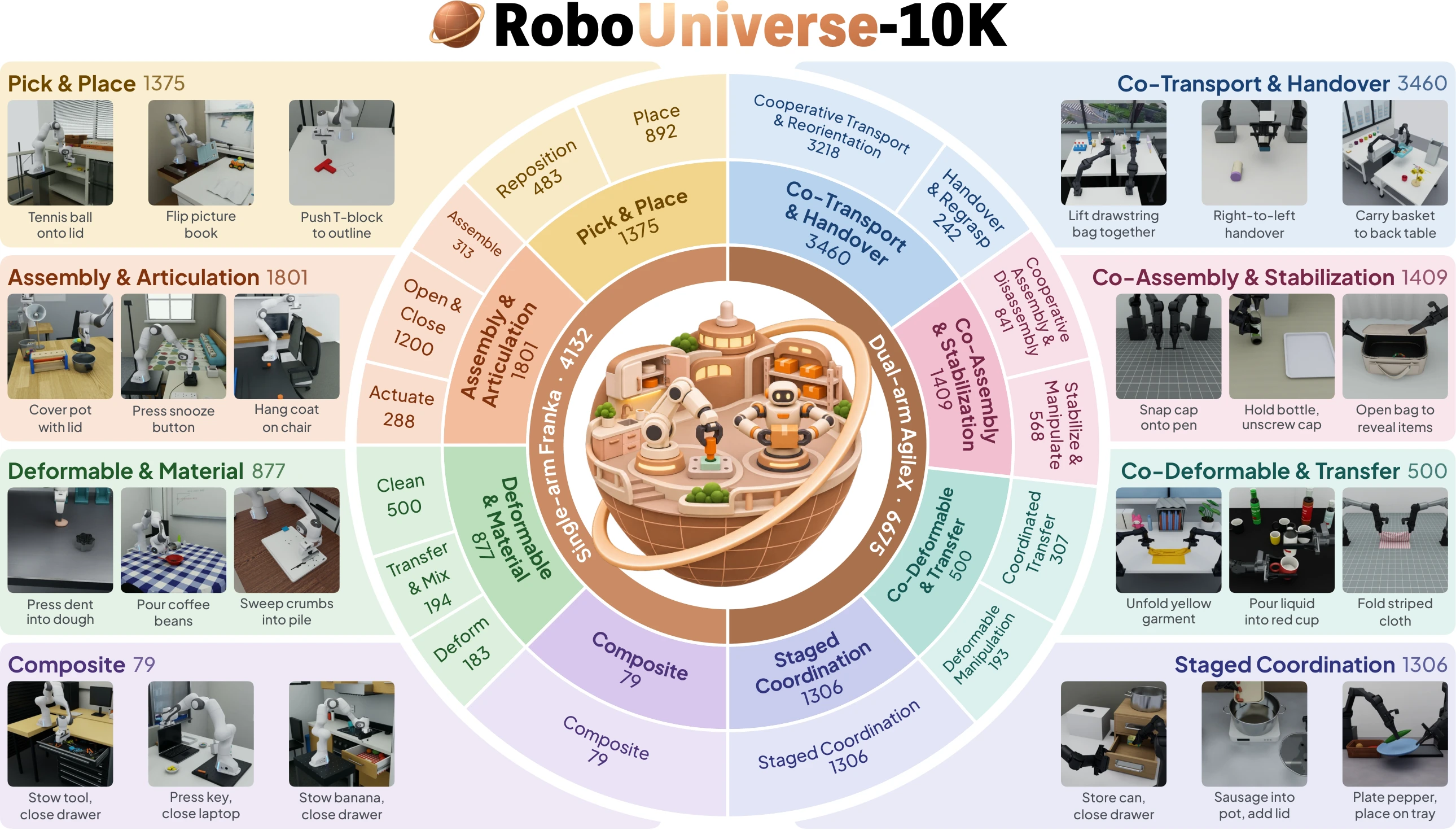
Foundation models can control robots by writing programs, observing the outcome, and revising their actions. Studying this capability requires diverse executable environments for both learning and held-out evaluation.
Real robot demonstrations ground task goals and scene construction. Resettable physics environments make repeated interaction and automatic verification possible.
RoboUniverse-Verified evaluates agents on 500 expert-verified tasks held out from training. The harness hides the simulator state and grading logic.
The collection supports trajectory generation and model post-training, with transfer studies extending beyond the source environments.
A coding agent constructs the scene, reference solution, and verifier. Independent quality checks examine source fidelity, reset-and-replay execution, and verifier robustness before packaging.
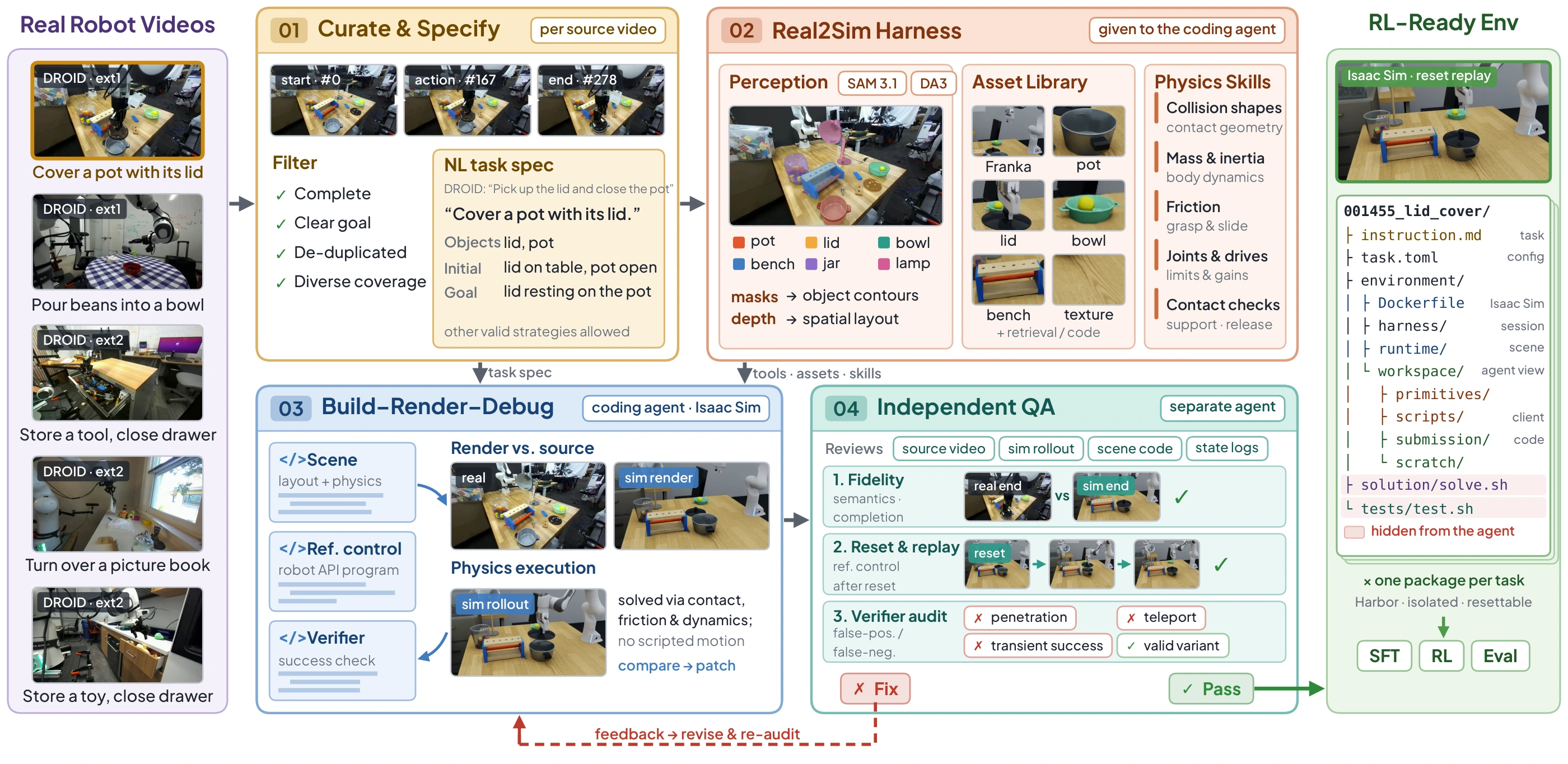
Filter source demonstrations for completeness and a clear goal. Specify the objects, initial state and intended outcome while allowing alternative valid strategies.
Provide perception tools, an asset library and physics-modeling skills covering contact geometry, mass, friction, joints and constraints.
Construct the scene, reference controller and verifier. Revise them using rendered-versus-source comparisons and physics-execution feedback.
Independently review source fidelity, reset-and-replay execution and verifier robustness. Return failures for revision before packaging an isolated environment.
An independent QA agent replays the reference controller from the initial state and checks whether it completes the intended task.
Checks cover source fidelity and invalid shortcuts, including penetration, teleportation and transient success states.
An embodied coding agent receives a manipulation goal and interacts with a resettable scene. It writes executable control code, observes the resulting state, and revises its approach over multiple turns.
Inspect the task and the observations available through the environment interface.
Write executable code that translates the goal into robot actions.
Run the control program in the physics simulation and receive feedback.
Use new observations to correct the plan and continue toward the goal.
The isolated, Harbor-compatible harness exposes the task interface while keeping privileged simulator state, the reference solution and grading logic hidden from the agent.
Task-specific verifiers evaluate the resulting environment state. A model’s claim of completion is not itself evidence that the goal has been achieved.
The full collection spans 4,132 Franka and 6,675 AgileX environments. The current RoboUniverse-Verified evaluation uses a held-out selection of 500 tasks. Collection counts on the cards describe the complete inventory, not the number of evaluated tasks in each family.
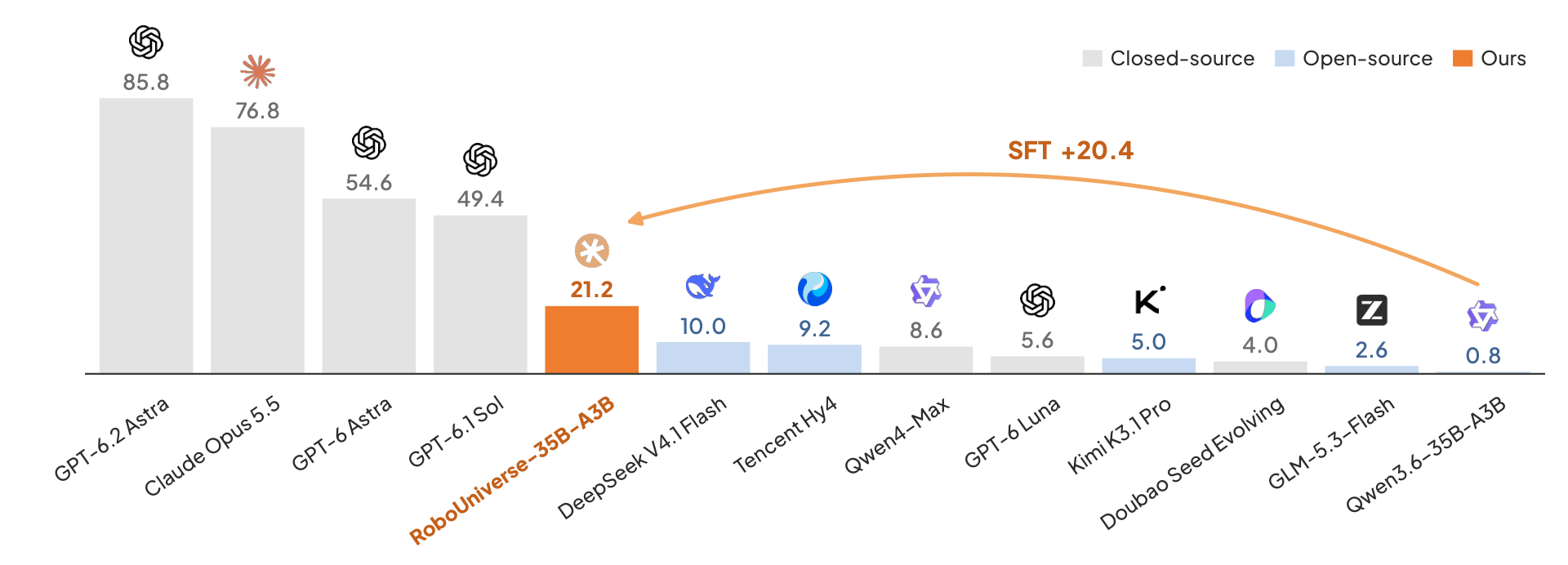
GPT-6.2 Astra (max) leads with 85.8% overall success, followed by Claude Opus 5.5 (max) at 76.8%. The evaluation covers 200 single-arm Franka tasks and 300 dual-arm AgileX tasks.
| Model | Harness | Effort | Single-arm | Dual-arm | Overall | ||||||
|---|---|---|---|---|---|---|---|---|---|---|---|
| Closed-source | |||||||||||
 GPT-6.2 Astra | Codex | max | 86.7 | 88.2 | 79.4 | 84.2 | 96.8 | 83.8 | 75.6 | 93.3 | 85.8 |
 Claude Opus 5.5 | Claude Code | max | 80.0 | 80.9 | 66.2 | 68.4 | 87.1 | 74.7 | 75.6 | 70.0 | 76.8 |
| GPT-6 Astra | Codex | max | 66.7 | 54.4 | 42.6 | 42.1 | 65.6 | 47.5 | 55.1 | 60.0 | 54.6 |
| GPT-6.1 Sol | Codex | max | 53.3 | 50.0 | 32.4 | 47.4 | 61.3 | 56.6 | 39.7 | 46.7 | 49.4 |
| GPT-6 Luna | Codex | max | 26.7 | 5.9 | 4.4 | 10.5 | 4.3 | 0.0 | 3.8 | 0.0 | 5.6 |
 Qwen4-Max | Claude Code | xhigh | 31.1 | 20.6 | 4.4 | 10.5 | 0.0 | 5.1 | 6.4 | 0.0 | 8.6 |
 Doubao-Seed-Evolving-1105 | Claude Code | high | 15.6 | 10.3 | 5.9 | 0.0 | 1.1 | 0.0 | 1.3 | 0.0 | 4.0 |
| Open-source | |||||||||||
 DeepSeek-V4.1-Flash-1017 | Claude Code | max | 33.3 | 17.6 | 8.8 | 5.3 | 2.2 | 7.1 | 7.7 | 3.3 | 10.0 |
 Tencent-Hy4 | Claude Code | high | 20.0 | 19.1 | 14.7 | 26.3 | 2.2 | 3.0 | 2.6 | 6.7 | 9.2 |
 Kimi-K3.1-Pro | Claude Code | max | 11.1 | 5.9 | 4.4 | 5.3 | 2.2 | 2.0 | 10.3 | 0.0 | 5.0 |
 GLM-5.3-Flash | Claude Code | max | 8.9 | 5.9 | 4.4 | 5.3 | 0.0 | 1.0 | 0.0 | 0.0 | 2.6 |
| Model | Harness | Effort | Single-arm | |||
|---|---|---|---|---|---|---|
| Closed-source | ||||||
| GPT-6.2 Astra | Codex | max | 86.7 | 88.2 | 79.4 | 84.2 |
| Claude Opus 5.5 | Claude Code | max | 80.0 | 80.9 | 66.2 | 68.4 |
| GPT-6 Astra | Codex | max | 66.7 | 54.4 | 42.6 | 42.1 |
| GPT-6.1 Sol | Codex | max | 53.3 | 50.0 | 32.4 | 47.4 |
| GPT-6 Luna | Codex | max | 26.7 | 5.9 | 4.4 | 10.5 |
| Qwen4-Max | Claude Code | xhigh | 31.1 | 20.6 | 4.4 | 10.5 |
| Doubao-Seed-Evolving-1105 | Claude Code | high | 15.6 | 10.3 | 5.9 | 0.0 |
| Open-source | ||||||
| DeepSeek-V4.1-Flash-1017 | Claude Code | max | 33.3 | 17.6 | 8.8 | 5.3 |
| Tencent-Hy4 | Claude Code | high | 20.0 | 19.1 | 14.7 | 26.3 |
| Kimi-K3.1-Pro | Claude Code | max | 11.1 | 5.9 | 4.4 | 5.3 |
| GLM-5.3-Flash | Claude Code | max | 8.9 | 5.9 | 4.4 | 5.3 |
| Model | Harness | Effort | Dual-arm | |||
|---|---|---|---|---|---|---|
| Closed-source | ||||||
| GPT-6.2 Astra | Codex | max | 96.8 | 83.8 | 75.6 | 93.3 |
| Claude Opus 5.5 | Claude Code | max | 87.1 | 74.7 | 75.6 | 70.0 |
| GPT-6 Astra | Codex | max | 65.6 | 47.5 | 55.1 | 60.0 |
| GPT-6.1 Sol | Codex | max | 61.3 | 56.6 | 39.7 | 46.7 |
| GPT-6 Luna | Codex | max | 4.3 | 0.0 | 3.8 | 0.0 |
| Qwen4-Max | Claude Code | xhigh | 0.0 | 5.1 | 6.4 | 0.0 |
| Doubao-Seed-Evolving-1105 | Claude Code | high | 1.1 | 0.0 | 1.3 | 0.0 |
| Open-source | ||||||
| DeepSeek-V4.1-Flash-1017 | Claude Code | max | 2.2 | 7.1 | 7.7 | 3.3 |
| Tencent-Hy4 | Claude Code | high | 2.2 | 3.0 | 2.6 | 6.7 |
| Kimi-K3.1-Pro | Claude Code | max | 2.2 | 2.0 | 10.3 | 0.0 |
| GLM-5.3-Flash | Claude Code | max | 0.0 | 1.0 | 0.0 | 0.0 |
We study supervised post-training on multi-turn robot interaction, using Qwen3.6-35B-A3B as the base model for RoboUniverse-35B-A3B. Evaluation covers held-out manipulation and transfer beyond the source collection.
GPT-6 Astra (medium effort) generated about 17,000 multi-turn training trajectories totaling 0.79 billion tokens.
We fine-tuned the full language backbone of Qwen3.6-35B-A3B with supervised learning, keeping the vision encoder and aligner frozen.
Compare the resulting model on held-out tasks and assess transfer to additional simulated environments and a physical robot.
| Model | OverallFinal 500 · success rate (%) | Training | Single-armFranka · success rate (%) | Dual-armAgileX · success rate (%) |
|---|---|---|---|---|
| Qwen3.6-35B-A3B | 0.8 | Base model | 2.0 | 0.0 |
| RoboUniverse-35B-A3B Ours | 21.2 | Language-backbone SFT | 40.5 | 8.3 |
In zero-shot simulation trials, RoboUniverse-35B-A3B recovered a dropped pudding package in LIBERO-MAX, moved an apple from a counter to a sink in RoboCasa, and operated a switch in RoboTwin 2.0. On a physical Franka arm, it drew the Einsia logo on a whiteboard from a reference image. See Figures 12 and 13 in the paper.
Single-arm tasks study manipulation with one robot arm. Dual-arm tasks introduce complementary roles and coordinated actions across two arms. Each embodiment spans four task families, with reference demonstrations embedded below.
Grasping · articulation · material interaction
Handover · stabilization · coordinated contact
One arm manipulates objects, actuates articulated parts and works with deformable materials.
Two arms coordinate transport, handovers, assembly and deformable-object manipulation.
Grasp the white drawstring bag from both sides, lift it with both arms, and place it on the table.
Reference controller replay in simulation.
Paper, evaluation code and environment resources for RoboUniverse.
@article{liu2026robouniverse10kscalingeraagentic,
      title={RoboUniverse-10K: Toward the Scaling Era of Agentic Robotics via Real-to-Sim
              Environments},
      author={Jinkun Liu and Yingze Wang and Situ Wang and Deyao Hong and Mingju Gao and Wenyi
              Li and Yizhe Chi and Youjie Zheng and Kaisen Yang and Xiangyang Wang and
              Bingxiang He and Yuxin Zuo and Boyuan Chen and Yue Chen and Cheng Qian and
              Tianxing Chen and Huichi Zhou and Huaxiu Yao and Hao Tang and Hao Zhou and
              Ya-Qin Zhang and Calvin Xiao and Tiga Altman and Huan-ang Gao},
      journal = {arXiv preprint arXiv:2611.31002},
      year={2026},
      eprint={2611.31002},
      archivePrefix={arXiv},
      primaryClass={cs.RO},
      url={https://arxiv.org/abs/2611.31002},
}